
Aditya L1 News Today: Solar Eruption Shape Revealed
Aditya L1 news today: ISRO says VELC found a solar eruption expanded unevenly, not as a symmetric bubble. What it means for space weather, explained.
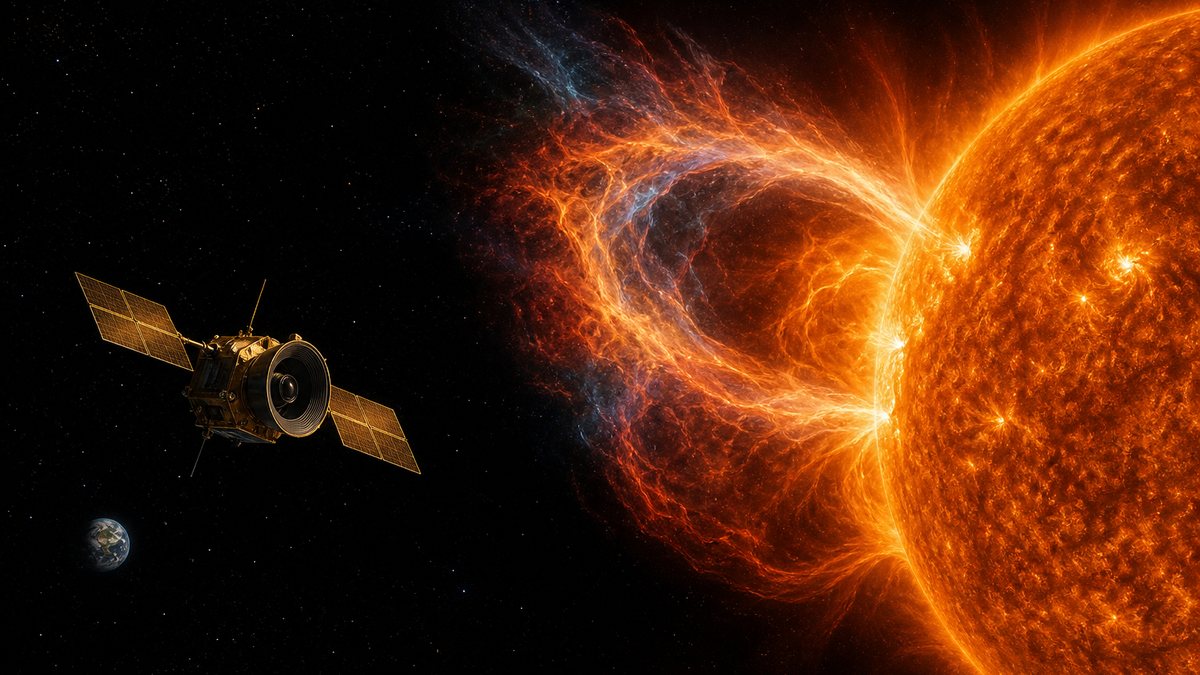
Aditya L1 news today: scientists using India's first space-based solar observatory have found that a huge solar eruption did not expand like a neat, round bubble. ISRO published the finding on its website on 3 November 2026. Researchers at the Indian Institute of Astrophysics (IIA), Bengaluru, used the Visible Emission Line Coronagraph (VELC) on Aditya-L1 to show that a coronal mass ejection seen on 5 August 2024 grew unevenly and took an asymmetric, tilted shape.
What is the Aditya L1 news today?
As per ISRO's note, the IIA team combined spectroscopic observations from VELC with images from NASA's Solar Dynamics Observatory (SDO) and a three-dimensional model. The study, published in The Astrophysical Journal Letters, says the 5 August 2024 eruption showed "non-uniform expansion". Earlier CME observations and models mostly assumed that such eruptions were symmetric bubbles.
The result matters because the shape of an eruption can change how fast it travels towards Earth. ISRO says CMEs with different shapes may feel different levels of drag from the solar wind, which can make arrival-time predictions harder.
What is a coronal mass ejection (CME)?
A coronal mass ejection is a massive burst of hot, magnetised plasma released from the Sun's outer atmosphere, called the corona. When a CME is aimed at Earth, it can contribute to space-weather disturbances that affect satellites and communication systems, according to ISRO. Predicting a CME's speed and path therefore has practical value, and that depends on knowing how it evolves in three dimensions close to the Sun, where it changes fastest.
How did Aditya-L1's VELC find the uneven expansion?
Most coronagraphs block the bright face of the Sun and capture only a flat, two-dimensional picture of the faint corona. They can show motion across the sky but not how fast plasma moves towards or away from the observer. VELC adds spectroscopy. It was developed by IIA with substantial support from ISRO and measures the Doppler shift of light from moving plasma, the same principle as a traffic speed gun.
During the August 2024 eruption, VELC recorded two separate Doppler-shifted emission branches on opposite sides of the normal coronal line. One was shifted to shorter (blue) wavelengths, showing plasma moving towards the instrument. The other was shifted to longer (red) wavelengths, showing plasma moving away. The team built a 3D model of an expanding shell-like CME. A perfectly symmetric shell could not reproduce what VELC saw. Adding uneven sideways expansion and a tilt gave an excellent match.
ISRO adds that this shows VELC can help pin down the 3D geometry of an eruption from a single vantage point, when combined with imaging data. Such 3D studies are often done with several spacecraft viewing from different angles.
About Aditya-L1: India's first solar mission
Aditya-L1 was launched on a PSLV rocket on 2 September 2023, according to a Government of India press release. ISRO's mission page says it was inserted into a halo orbit around the Sun-Earth Lagrange point 1 (L1) on 6 January 2024. L1 lies about 1.5 million km from Earth, and from there the spacecraft can watch the Sun continuously without eclipses. It carries seven payloads: four study the Sun remotely and three measure the local environment at L1. VELC is one of the four remote-sensing instruments.
This is not the only recent ISRO milestone. Separately, ISRO's GSLV-F18 successfully launched the NVS-03 navigation satellite. India is also working on other frontier science, such as the SST-1 "artificial sun" fusion research effort.
Aditya L1 news today kya hai? (Hinglish)
Aditya-L1 ke VELC instrument ne dikhaya ki 5 August 2024 ka solar eruption (CME) ek gol bubble ki tarah barabar nahi phaila, balki tedha aur asymmetric tha. ISRO ke mutabik isse space weather aur CME ke Earth tak pahunchne ka time samajhne mein madad mil sakti hai.
FAQ
What is Aditya-L1? India's first space-based solar observatory, launched on 2 September 2023 and stationed in a halo orbit around the Sun-Earth L1 point.
What did Aditya-L1 discover? That a solar eruption seen on 5 August 2024 expanded unevenly and took an asymmetric shape, instead of expanding as a symmetric bubble.
Does this CME finding affect Earth right now? No. The studied eruption happened in August 2024. The finding is about improving future space-weather understanding, not a new alert.
Sources: ISRO: Aditya-L1 Reveals the Hidden Third Dimension of a Solar Eruption (3 Nov 2026). Research paper, The Astrophysical Journal Letters (DOI 10.3847/2041-8213/aea295). ISRO: Aditya-L1 mission page. PIB: Aditya-L1 launch on 2 Sep 2023.
Get every new startup story on WhatsApp.
Join our WhatsApp Channel