Is India building an 'artificial sun'? What's built, what's planned
India is building its 'artificial sun' but hasn't built one yet. IPR Gandhinagar has added a new 82.6 GHz gyrotron to its SST-1 tokamak, and a proposed SST-Bharat reactor and a 2060 demo plant are on the roadmap. Fusion power for homes is still decades away.
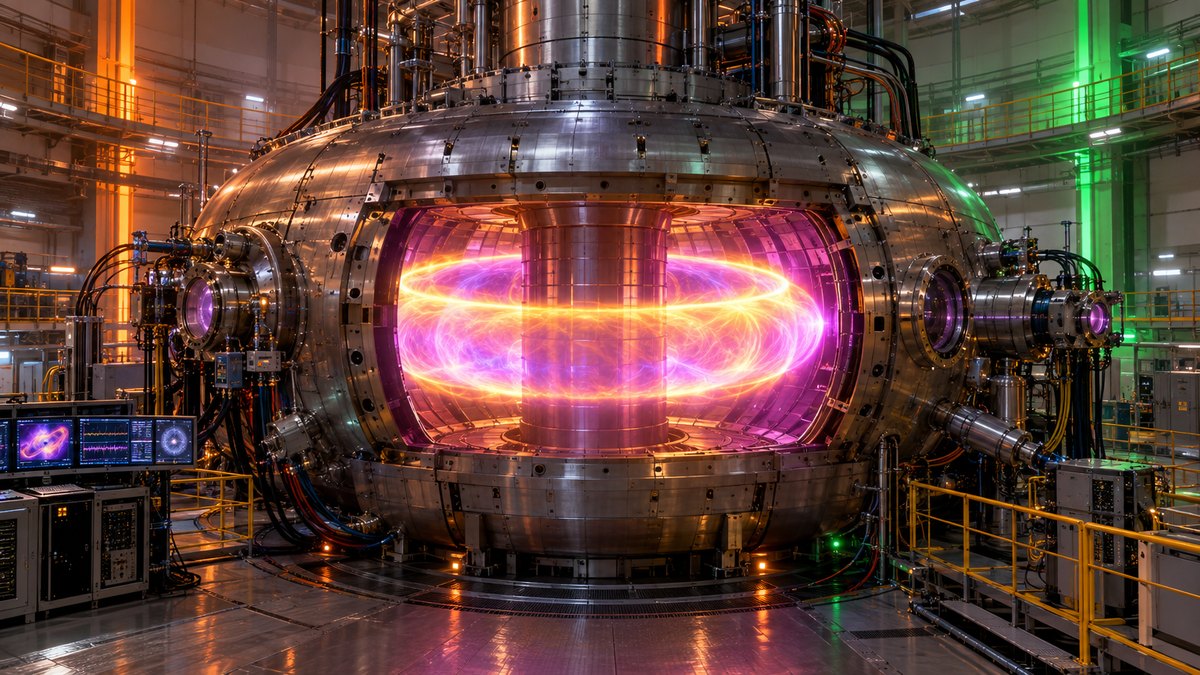
Videos calling India's work on an "artificial sun" a historic breakthrough are going viral. So has India built one? Not yet. India is building it. Here is what exists today and what is still on the drawing board.
What is an "artificial sun"?
The Sun shines because of nuclear fusion: in its core, hydrogen nuclei fuse into helium and release huge amounts of energy. The Sun's gravity keeps that hot plasma squeezed together. Earth can't copy that gravity, so scientists heat fuel into plasma at more than 100 million °C, several times hotter than the Sun's core. They then hold it in place with powerful magnets inside a doughnut-shaped machine called a tokamak. "Artificial sun" is the popular nickname for these machines.
What India has already built
- ADITYA (1989): India's first tokamak, commissioned in 1989 at the Institute for Plasma Research (IPR), Gandhinagar. It now runs in an upgraded form as ADITYA-U.
- SST-1: IPR's Steady State Superconducting Tokamak, an experimental machine used to study how plasma behaves and how to control it.
- New gyrotron (September 2026): IPR installed and commissioned a new 82.6 GHz, 400 kW gyrotron on SST-1. A gyrotron is a powerful microwave source that heats the plasma (a method called electron cyclotron resonance heating). The new system can deliver up to 400 kW in pulses of up to 0.5 seconds, a big step up from the older 42 GHz system. This is the recent "milestone" behind the viral posts.
- ITER: India has been a partner in ITER, the giant international fusion reactor being built in France, since 2005. It supplies 9% of ITER's in-kind contributions, including the huge cryostat.
What is still planned
In September 2025, IPR researchers proposed a roadmap to fusion power:
- SST-Bharat: a planned fusion-fission hybrid machine with an output five times its input. Of its 130 MW, 100 MW would come from fission. Estimated cost: ₹25,000 crore.
- Demo reactor by 2060: the long-term target is a full demonstration reactor producing 250 MW, with output 20 times its input.
These are proposals and targets, not approved projects with fixed dates.
A startup has joined the race too
In September 2026, Bengaluru startup Pranos unveiled PRAGYA, which it calls India's first privately built tokamak. The company says PRAGYA cannot produce fusion yet. It is a test bed for a bigger reactor, Praniq, which Pranos is aiming for by around 2030. Pranos raised $6.8 million this year.
Fact check
- "India is building an artificial sun": True. IPR runs research tokamaks, and the gyrotron is a real 2026 upgrade.
- "India has built a machine that gives us electricity": False. As the New Indian Express notes, the new gyrotron is a lab instrument and will not generate electricity for homes. No fusion machine anywhere supplies power to the grid yet.
- Some viral posts also claim India became the world's "4th country" in fusion in 2016 or quote a cost for SST-1. Day1 could not confirm these in credible sources, so we have left them out.
Why it matters
Fusion could one day give clean power with very little long-lived nuclear waste. For now, India's progress is in the skills it is building: heating plasma, superconducting magnets, and parts for ITER. Those are what a future Indian fusion plant would be built on.
Sources: The Federal (15 Sep 2026), CNBC TV18 (15 Sep 2026), The New Indian Express (28 Oct 2026), The Hindu (Sep 2025), ThePrint (Sep 2026), ITER India.
Get every new startup story on WhatsApp.
Join our WhatsApp Channel